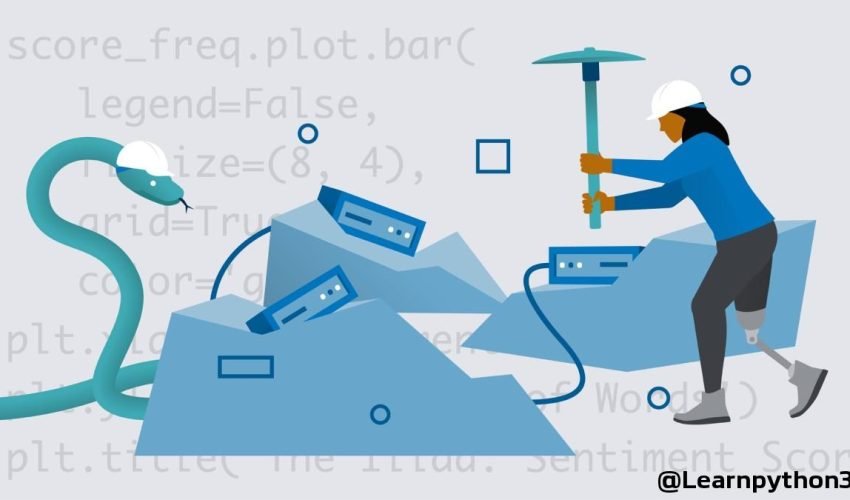
Extract hidden insights from raw data. Master the core data mining algorithms, exploratory data analysis workflows, and predictive modeling techniques using industry-standard Python libraries like Pandas, Scikit-Learn, and Seaborn.
Course Description
Data is the new oil. But it’s worthless if you don’t know how to refine it.
Every single second, businesses generate billions of data points. Hidden within those sprawling spreadsheets and chaotic databases are the patterns, trends, and anomalies that dictate market trends, forecast consumer behavior, and prevent systemic risks. Organizations don’t just need people who can organize data—they need professionals who can mine it for actionable intelligence.
Data Science Foundations: Data Mining in Python is a rigorous, practical introduction to the bedrock techniques of data discovery. This course completely bypasses abstract academic theory to put you in the driver’s seat of real-world datasets.
You will master the end-to-end data mining pipeline using Python, the world’s most popular language for data science. From data preprocessing and cleaning to handling missing values, you will quickly transition into advanced exploratory data analysis ($EDA$). From there, you’ll implement high-demand machine learning models—covering clustering, classification, and association rule mining.
By the time you finish this course, you will be able to confidently transform massive, unstructured datasets into predictive models and beautiful visual stories that drive executive decision-making.
What You’ll Learn
-
The Data Mining Pipeline: Implement the complete CRISP-DM framework from data ingestion to model evaluation.
-
Data Preprocessing & Cleaning: Master methods for handling missing data, identifying outliers, and normalizing features using Pandas.
-
Exploratory Data Analysis ($EDA$): Build stunning statistical visualizations with Matplotlib and Seaborn to uncover hidden distributions.
-
Classification Algorithms: Train and evaluate predictive models using Decision Trees, Naive Bayes, and k-Nearest Neighbors ($k$-NN).
-
Clustering & Pattern Recognition: Segment customer profiles and discover natural groupings using $k$-Means and Hierarchical Clustering.
-
Association Rule Mining: Implement the Apriori algorithm to uncover market basket insights and cross-selling opportunities.
Skills You’ll Gain
-
Data Preprocessing & Wrangling
-
Exploratory Data Analysis ($EDA$)
-
Unsupervised Machine Learning
-
Predictive Modeling & Evaluation
-
Python Data Science Stack (Pandas, NumPy, Scikit-Learn, Seaborn)